
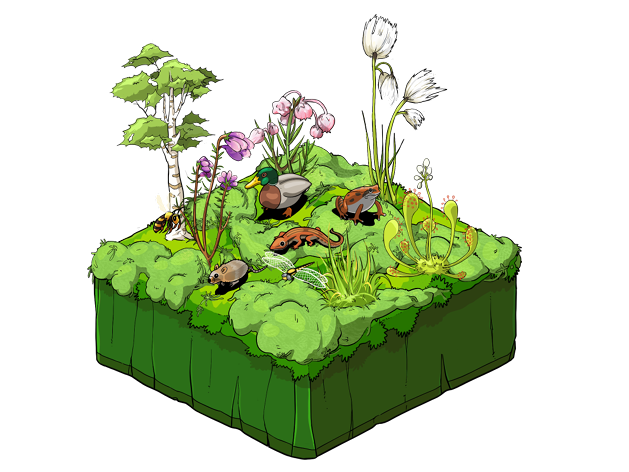
Illustration issue du jeu Tourbanisation
Creartstudio - François Boggio
To make the game accessible, some scientific processes have been deliberately simplified. The aim is not to reproduce reality in every detail, but to help players understand key ecological relationships through gameplay. Find out more about the project here!
Restore peatlands, build a sustainable future
Imagine… You've arrived on planet Junon. Your mission is to create a sustainable future for its inhabitants by developing the territory while protecting its fragile peatland ecosystems.
As infrastructure expands and the population's needs grow, every decision affects the environment. Will you restore wetlands, encourage biodiversity or make room for new developments?
But life on Junon is unpredictable. At the end of each turn, climate events such as droughts, heavy rainfall, heatwaves and wildfires can disrupt your plans and upset the ecological balance.
Can you secure a sustainable future for planet Junon?
How to play
A game takes approximately 20 minutes and unfolds over several turns. Your goal is to keep the peatlands healthy while supporting the development of the territory.
Tutoriel
JUNON
1. Explore and understand your environment
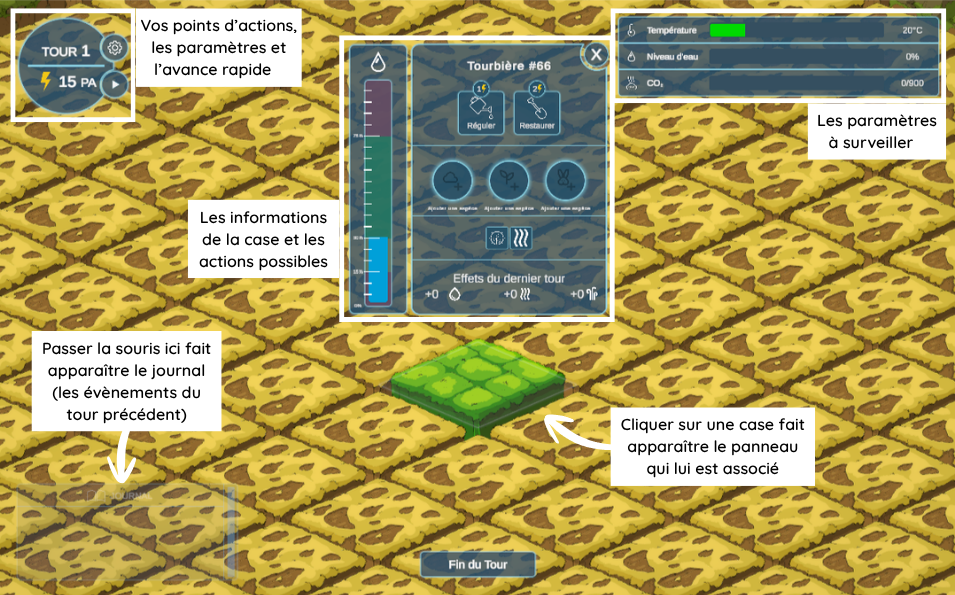
Each tile represents an area of peatland. Its appearance reflects its ecological health, including moisture levels, biodiversity and carbon storage capacity.
Keep an eye on several key indicators: water levels, CO₂ concentration, temperature and your available action points.
2. Restore the peatlands
You can rewet degraded areas to help restore their natural ecological functions. Once restored, peatlands can support vegetation and wildlife while helping to regulate the local climate.
Every action costs action points, so you'll need to make strategic choices.
3. Encourage biodiversity
When conditions are right, you can introduce different plant and animal species.
Each species plays a specific role in the ecosystem, whether it's capturing CO₂, regulating water, providing protection against certain climate events or interacting with other species.
4. Adapt to unexpected events
At the end of each turn, climate events may change the situation: droughts, heavy rainfall, heatwaves, wildfires and more.
You'll need to adjust your strategy as conditions evolve.
5. Develop your settlement
The territory must also evolve to meet the needs of its growing population.
During each urban development phase, you must choose one building from the available options. Each building affects the peatland ecosystem in different ways.
Please note: Each building represents a specific need of the human population, such as housing, food, energy or infrastructure. Together, they support the development of life on Junon.
- Apartment building: provides housing for Junon's growing population.
- Intensive farm: produces food to meet the population's needs.
- Water storage reservoir: stores and redistributes water for human use.
- Thermal power plant: generates the energy needed to power the settlement.
- Mine: extracts underground resources to support the economy and industry.
6. Find the right balance
After 15 turns, your management decisions are evaluated.
To succeed, you'll need to maintain sufficient water levels, protect biodiversity, limit CO₂ emissions, manage your resources efficiently and adapt your strategy to unexpected events.