

Anticipating changes in water resources through Artificial Intelligence
Climate change is increasing pressure on water resources. Droughts are becoming more frequent, river flows are increasingly variable, and certain forms of water quality degradation are intensifying. To address these challenges, water managers and local authorities need tools that help them anticipate critical situations and better prepare decisions and actions.
Selected under the DIAT call for projects (Resource-Efficient AI Demonstrators for the Ecological Transition of Territories) as part of France 2030, PrevizO is being implemented in the Nouvel Espace du Cher (NEC) area and brings together a broad consortium of public, scientific and private stakeholders.
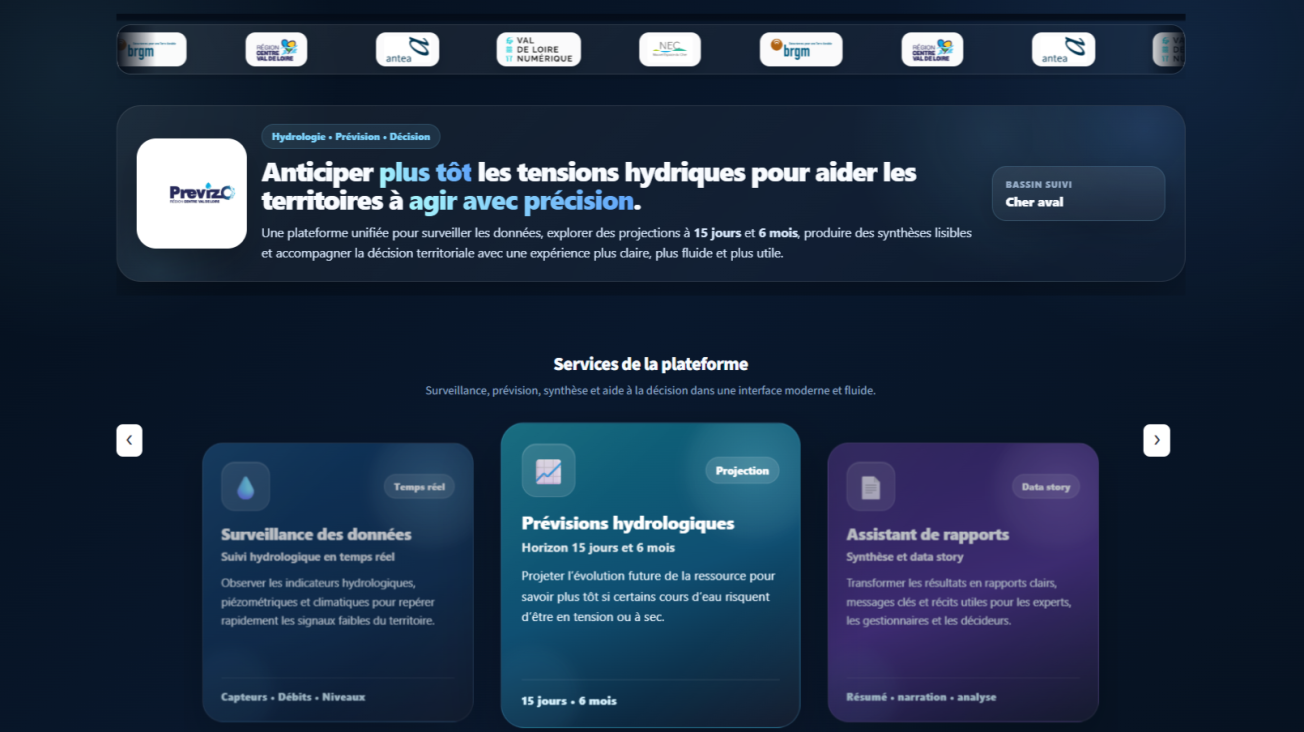
Aperçu de la plateforme PrevizO
PrevizO
Forecasting low-flow periods and droughts
One of PrevizO's main objectives is to improve the ability to anticipate water scarcity. The project is developing models capable of forecasting low-flow conditions over different time horizons:
- Short-term forecasts, up to 15 days ahead, to support water managers in monitoring river flows and preparing water-use restrictions;
- Medium-term forecasts, up to 6 months ahead, to facilitate discussions between different water users and anticipate adaptation strategies.
These forecasts support informed decision-making and strengthen the ability of local communities to anticipate drought events.
Monitoring changes in river flows
PrevizO also contributes to improving knowledge and monitoring of surface water resources. The data and models developed within the project make it possible to monitor changes in river flows and enhance the information available for quantitative water resource management. They may also contribute to updating certain indicators used in HMUC studies (Hydrology, Ecosystems, Water Uses and Climate) and in local water resource planning initiatives.
Anticipating water quality degradation
PrevizO is developing methods to anticipate the occurrence of algal blooms by combining satellite observations, environmental sensor data, hydrological and meteorological information, and artificial intelligence models. The objective is to identify potentially harmful conditions earlier, enabling the rapid implementation of prevention, monitoring or public health protection measures.
Resource-efficient and explainable artificial intelligence
PrevizO focuses on developing artificial intelligence tailored to the challenges of the ecological transition.
The tools developed follow several key principles:
- Resource efficiency, to minimise computational and digital resource requirements;
- Openness, to encourage the sharing and reuse of methods;
- Explainability, to make model outputs understandable;
- Replicability, to enable the approach to be deployed in other territories.
Artificial intelligence is designed here as a decision-support tool that complements the expertise of water management stakeholders and strengthens their ability to anticipate future challenges.
La coopérative des données climatiques en région Centre-Val de Loire
Région Centre-Val de Loire
A project emerging from the Climate Data Hub
PrevizO emerged from a collaborative initiative led by the Climate Data Hub, a consortium bringing together around thirty public and private organisations committed to helping territories adapt to climate change.
The Climate Data Hub acts as a trusted intermediary for data sharing and governance, an incubator for practical applications supporting public policies, and a collaborative platform connecting local authorities, government services, research institutions and businesses.
Project lead: