The programme unites around twenty research laboratories, higher education institutions, public organisations, businesses and socio-economic partners around a shared ambition: harnessing digital technologies to improve our understanding of the environment and support its sustainable management.
Governance supporting a shared ambition
The JUNON programme is built on a collaborative governance structure that ensures scientific coherence, the quality of research activities and their alignment with regional needs. This structure enables the coordination of stakeholders with complementary expertise, working towards a common goal: developing environmental digital twins to improve our understanding, management and anticipation of changes in natural environments.
The overall coordination of the programme is led by BRGM, which oversees the implementation of strategic priorities, facilitates collaboration among partners and monitors scientific and technical projects. As a leading organisation in geosciences and environmental research, BRGM contributes its expertise to programme management and the dissemination and application of research findings.
JUNON's governance structure includes several complementary bodies. The Strategic Orientation Committee (COS) defines the programme's main strategic priorities and ensures their alignment with scientific, socio-economic and regional challenges. The Scientific Steering Committee (CPS) is responsible for the operational coordination of activities and project monitoring. Two advisory bodies, the Scientific Committee and the Local Users and Contributors Committee, provide additional perspectives by encouraging dialogue between researchers, socio-economic partners and future users of the services developed.
This governance structure fosters dialogue across disciplines, encourages knowledge sharing and ensures that JUNON's activities remain closely aligned with the practical needs of local communities and stakeholders.
La Région Centre-Val de Loire
BRGM - Anouk Fronzes
A regional research and innovation ecosystem
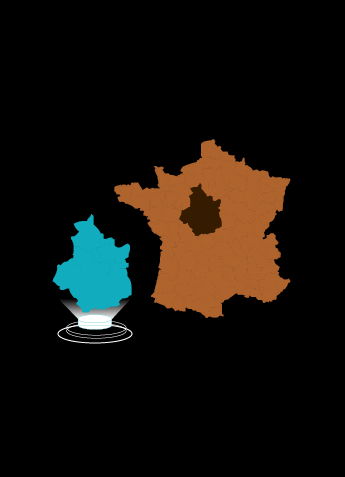
JUNON draws on a unique network of stakeholders in Centre-Val de Loire, bringing together around twenty research laboratories, higher education institutions, public organisations, local authorities, businesses and innovation support organisations. This diversity of partners is one of the programme's key strengths, fostering the interdisciplinary approaches essential to developing environmental digital twins.
By bringing together specialists in environmental sciences, geosciences, hydrology, agronomy, ecology, computer science, modelling, data science and artificial intelligence, JUNON creates a new space for collaboration at the regional level. This combination of expertise makes it possible to better understand how natural environments function and to develop innovative digital tools that address the challenges of sustainable natural resource management.
The programme also helps strengthen the region's scientific attractiveness by encouraging exchanges between academic research and socio-economic stakeholders. Local authorities, natural area managers, public institutions and businesses are involved in discussions to develop solutions tailored to practical needs and facilitate the transfer of research findings into real-world applications.
Beyond generating scientific knowledge, JUNON therefore contributes to the development of a regional sector dedicated to environmental data, digital technologies and associated services.
Fostering collaboration and international engagement
One of the programme's main ambitions is to foster synergies between the digital and environmental research communities. By combining expertise from these two fields, JUNON contributes to the emergence of new interdisciplinary approaches and the development of innovative solutions to address today's environmental challenges.
The programme also aims to strengthen the national and international visibility of research conducted in Centre-Val de Loire. To achieve this, it builds on the region's distinctive environmental characteristics, which make it a large-scale open-air laboratory for studying agricultural, forest, river and urban environments. This environmental diversity, combined with the excellence of the research teams involved, provides particularly favourable conditions for developing major scientific collaborations.
In this context, LE STUDIUM, the Centre-Val de Loire Institute for Advanced Studies, supports the programme by coordinating several initiatives designed to strengthen its scientific outreach and international engagement. Conferences, seminars and thematic workshops are organised around JUNON's key research areas, particularly environmental sciences, data, digital technologies and artificial intelligence. These events encourage exchanges between researchers, public authorities, businesses and international partners.
The involvement of international researchers also helps enrich the programme's research activities. Their expertise strengthens the research capabilities of regional teams, encourages the exchange of new methodologies and contributes to the development of open practices in environmental data. These collaborations help enhance expertise within the regional ecosystem while increasing its visibility and influence at European and international levels.
Avec le soutien de la Région Centre-Val de Loire
Région CVL
Funding
The JUNON programme is supported by the Centre-Val de Loire Regional Council through the Ambition Research and Development (ARD) scheme, established to support the development of major research programmes addressing the region's scientific, environmental and socio-economic challenges. This support reflects the region's commitment to making research and innovation key drivers of development and adaptation to ongoing transitions.
The programme was launched thanks to a regional grant of €6 million, supplemented by financial and in-kind contributions from all participating partners. This collective commitment represents an initial total budget of over €12 million, allocated to developing infrastructure, supporting research projects and encouraging the emergence of new services based on environmental data.
JUNON also benefits from the support of several complementary projects and funding schemes. The CPER CONEX project contributes in particular to strengthening digital infrastructure and improving scientific data connectivity. Other initiatives, such as the COINS and JUMP projects, help enrich the regional innovation ecosystem and foster new collaborations.
Together, these funding sources support the development of an ambitious and sustainable programme, capable of bringing regional stakeholders together around a shared vision: harnessing data, research and digital technologies to better understand, protect and sustainably manage the environment.
Coordination

Responsable de la coordination & de l'animation interne
BRGM - Direction de l'Eeu - Unité des Données et référentiel des eaux souterraines
BRGM,
3 avenue Claude Guillemin, BP36009
45100 Orléans
France
Your contacts for partnerships:

Le STUDIUM
1 Rue Dupanloup
45000 Orléans
France

Le STUDIUM
1 Rue Dupanloup
45000 Orléans
France

INRAE Val de Loire
2163 avenue de la pomme de pin CS 40001, Ardon
45075 Orléans
France